

When you are choosing a commercial garage door for maximum energy efficiency, knowing the difference between U-factor and U-value is critical. They sound like they should mean the same thing, and a lot of spec sheets use them loosely, but they measure insulation in different ways. Mixing them up can lead to comparing two doors that are not comparable.
For both U-factor and U-value, lower is better. But only one of them, U-factor, is based on testing the entire door as it is installed, which is why it should drive your buying decision for many commercial door projects.
No. U-value is usually a calculated measurement for a single door section or slat. U-factor is a tested measurement of the full installed door assembly, including sections, joints, hardware, seals, and perimeter construction. Lower is better for both, but the two numbers should not be used interchangeably.
What Is U-Factor?
U-factor is a measure of thermal transmittance, expressed in Btu/(h·ft²·°F). It describes how much heat moves through the entire installed door assembly, not just the insulation material, when there is a temperature difference between the inside and outside.
Garage door U-factor is tested under ANSI/DASMA 105, the industry standard recognized by the International Energy Conservation Code as the official thermal test method for garage doors. The standard is based on ASTM E1423. In the test, a complete door is installed at an independent lab, one side is held at a constant temperature, the other side is cooled, and the rate of heat transfer between the two is measured directly.
According to DASMA, the resulting number accounts for the door sections, the section joints and interfaces, the assembled hardware, and the perimeter design and construction, not just the panel material. The lower the U-factor, the slower heat moves through the door. DASMA thermal-performance guidance puts it in concrete terms: a door rated 0.20 is twice as efficient as one rated 0.40.
What Is U-Value?
U-value, sometimes called simply “U” outside the door industry, describes thermal transfer at a single point in the door, typically the section or slat, rather than the whole assembly. It is calculated, not tested, and it is commonly treated as another way of expressing R-value. Door manufacturers make the same distinction in consumer-facing insulation guidance, including Wayne Dalton garage door insulation guidance.
R-value and U-value describe the same underlying property from opposite directions. R-value is reported in (h·ft²·°F)/Btu, and a higher R-value means better insulation. U-value is reported in Btu/(h·ft²·°F), and a lower U-value means better insulation.
For a single, uniform material, U and R are mathematical reciprocals. Where it gets more complicated for garage doors is that R-value for a door section is calculated using assumed conditions and only covers the section. It does not touch the joints, the hardware, or how the door behaves once it is hung in an opening. That is the gap U-factor testing closes.
Is a Lower U-Factor or U-Value Better?
Yes. For both measurements, lower means less heat is getting through the door, which means better insulation and more stable temperatures on the other side.
The important distinction is scope. A low U-value calculated at a single section does not guarantee a low U-factor once the whole overhead sectional door, hardware and all, is tested as an assembly. That same assembly-level thinking applies when evaluating commercial garage door components over the life of the opening.

RCI Doors™ can help compare door ratings using the full installed assembly, not just panel insulation claims.
U-Factor vs. R-Value: What Is the Real Difference?
U-factor and R-value are often presented as simple inverses of each other, and for a single material in isolation, that is true. But DASMA guidance on garage doors is explicit that, for evaluating a garage door’s real-world thermal properties, U-factor and R-value are not reciprocals of each other.
The reason is scope, not math. R-value is a calculation limited to the door section, while U-factor is a physical test of the complete installed assembly. Two doors can carry the same advertised R-value and still perform differently once you account for hardware, seals, and how the panels fit together. That is why U-factor has become the number the industry and building codes rely on.
How U-Factor Is Tested for Garage Doors
U-factor testing under ANSI/DASMA 105 happens at an independent laboratory with a complete door installed in a test chamber. DASMA also runs a Thermal Performance Verification Program with ICC-ES, where manufacturers submit third-party lab data and, once verified, can display DASMA’s verification badge on qualifying products.
That program currently covers sectional doors with 16% window area or less. Rolling steel doors and high-speed doors are outside its scope, along with air infiltration and solar heat gain, which the U-factor test does not measure.
That does not mean a rolling steel door cannot have a tested U-factor. It means it will not carry DASMA’s specific verification badge. Cornell’s Thermiser Max Low-U rolling door, for example, is tested to ANSI/DASMA 105-2017 by an independent lab, outside the sectional-door verification program.
Why This Matters for Commercial Garage Doors
For a facility manager, this is not an academic distinction. Commercial building energy codes lean on U-factor, not R-value, for compliance. ASHRAE Standard 90.1, which many commercial energy codes reference, requires door U-factors that follow NFRC 100 whole-product testing procedures, and compliance software like COMcheck expects U-factor data when documenting a project.
If a U-factor was not developed using NFRC 100 procedures, Standard 90.1 default values apply instead. Those defaults represent poorly performing doors, which can create real compliance problems when door area is a meaningful share of the wall.
In practice, the U-factor on your door spec is not just a marketing number. It can be the number an inspector or energy code reviewer checks, especially for conditioned warehouses, service bays, and facilities with large loading dock openings.
Before you choose a commercial garage door, RCI Doors™ can help review U-factor, R-value, door type, and code needs.
U-Factor and Real Cost Savings: The Thermiser Max Low-U Example
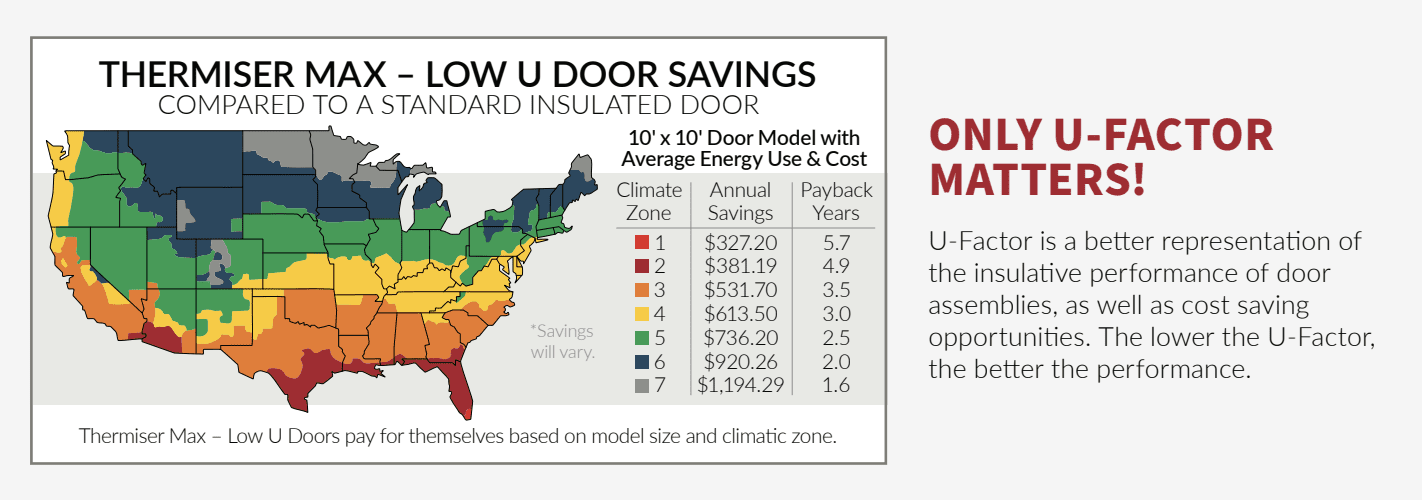
Cornell’s Thermiser Max Low-U is one of the lowest U-factor ratings in the rolling steel door category, tested at U-factor 0.532 under ANSI/DASMA 105-2017. Clopay Corporation, Cornell’s parent company, publishes a savings comparison for a 10-foot by 10-foot Thermiser Max Low-U door against a standard insulated door, based on average energy use and cost by U.S. climate zone.
Savings will vary by model size and local energy costs, but the published figures give a useful sense of scale:
| Climate Zone | Annual Savings | Payback Period |
|---|---|---|
| 1 | $327.20 | 5.7 years |
| 2 | $381.19 | 4.9 years |
| 3 | $531.70 | 3.5 years |
| 4 | $613.50 | 3.0 years |
| 5 | $736.20 | 2.5 years |
| 6 | $920.26 | 2.0 years |
| 7 | $1,194.29 | 1.6 years |
Colder climate zones see the fastest payback because there is a bigger temperature difference for a low-U-factor door to hold back. This is manufacturer-published data for one specific door and size, not a guarantee for every project, but it illustrates why U-factor is worth paying attention to on a purchase decision.
U-Factor Outside Garage Doors
U-factor terminology also shows up in windows, skylights, and general building-envelope work, where NFRC 100 is the standard reference method. The underlying concept is the same: whole-assembly thermal transmittance, where lower is better.
Garage doors are tested to their own industry standard, ANSI/DASMA 105, rather than NFRC 100 directly, because a garage door assembly behaves differently from a window or skylight.
How to Compare U-Factor Ratings When You Are Buying
A few points are worth checking before you compare two doors on U-factor alone:
- Confirm the number is a tested U-factor, not a calculated R-value relabeled as U.
- Check whether the rating covers the whole door assembly or only the insulated panel.
- For rolling steel or high-speed doors, do not expect a DASMA verification badge, but still ask for the underlying test data.
- If the door needs to satisfy a commercial energy code, confirm which U-factor procedure the project documentation requires.
- Compare doors within the same door type and use case, because an insulated sectional door, a rolling steel door, and a high-speed door solve different facility problems.
Download the U-Factor vs. U-Value Info Sheet
RCI Doors™ has a quick visual info sheet showing how U-factor affects door performance, along with the climate-zone savings and payback table above for the Thermiser Max Low-U door.
Download the U-Value vs. U-Factor Info Sheet.
Recommended Next Steps
If you are comparing insulated commercial garage doors, start with the full installed assembly rating. U-factor gives you a better picture than panel R-value alone because it accounts for the door as it actually performs in the opening.
RCI Doors™ helps commercial facilities compare, install, and service insulated sectional doors, rolling steel doors, high-speed doors, and related loading dock equipment. For help reviewing a door rating or choosing a replacement, contact RCI Doors™ for commercial door service and repairs.
RCI Doors™ can recommend the right commercial garage door for performance, durability, traffic, and code requirements.
When comparing commercial garage door insulation, U-factor is the better decision number because it reflects the whole installed assembly. R-value and U-value can help explain material performance, but they should not replace tested whole-door data.
RCI Doors™ helps commercial facilities compare door ratings, select the right insulated or high-performance door, and keep door systems working safely after installation.


