
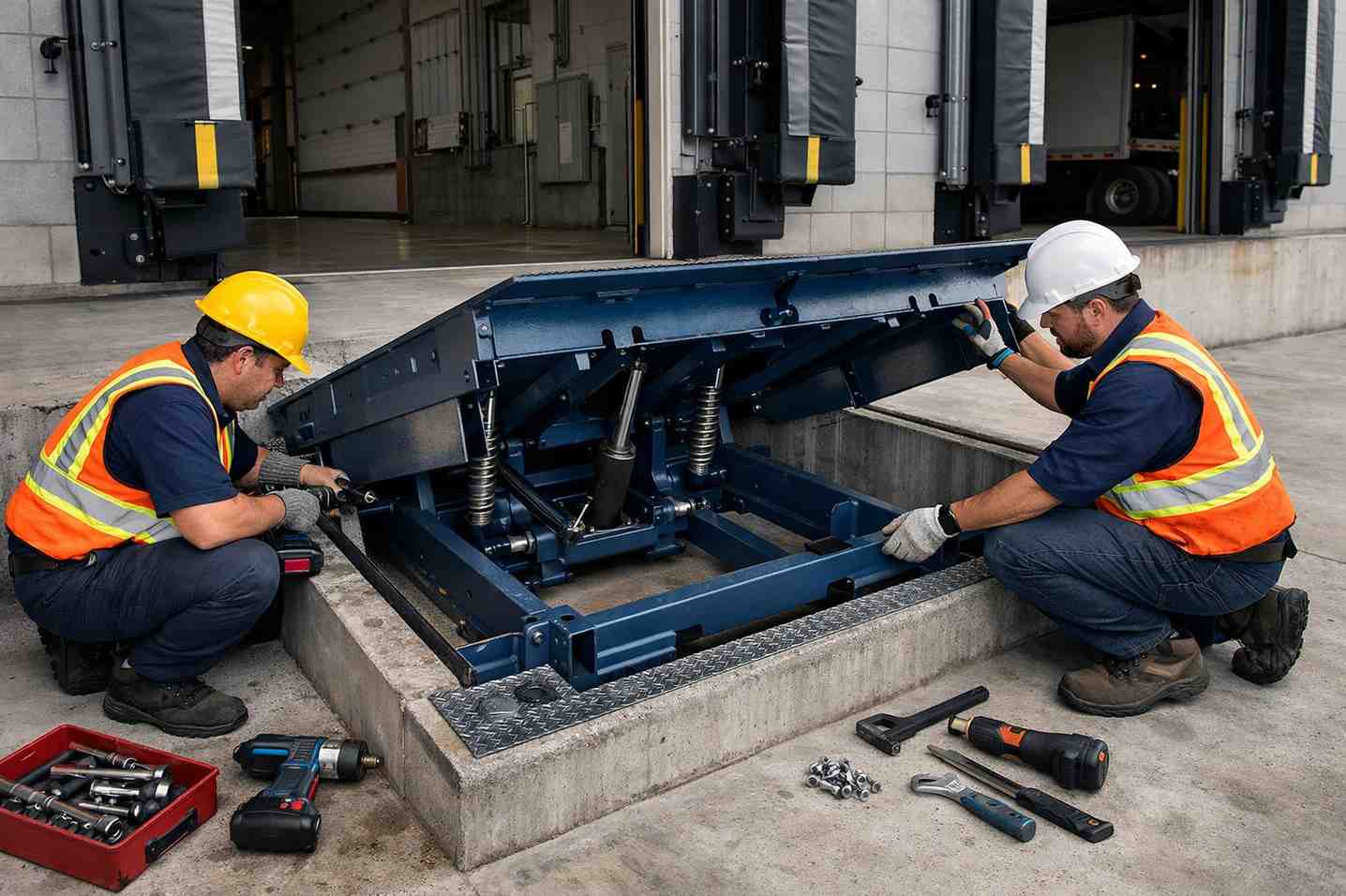

| Factor | Dock Leveler | Dock Lift |
|---|---|---|
| Best facility fit | Traditional raised dock with regular truck traffic | Ground-level facility, no permanent dock, or varying truck heights |
| Primary job | Bridge a gap between dock floor and trailer bed | Raise or lower freight between two elevations |
| Workflow speed | Faster for repeat trailer loading at dedicated dock positions | More flexible, but usually slower per cycle |
| Typical investment logic | Lower initial investment when the dock is already built | May cost more upfront but avoids dock construction |
| Best use case | Warehouses, plants, and distribution centers with predictable loading lanes | Smaller facilities, mixed delivery vehicles, and grade-level receiving |
Understanding the Difference
Loading docks are designed to keep goods moving efficiently, but choosing the wrong equipment can slow operations, increase maintenance costs, and create safety challenges. If you’re deciding between a dock leveler and a dock lift, the answer depends less on which product is “better” and more on how your facility operates.
This dock leveler vs dock lift comparison explains the differences, ideal use cases, and key factors to consider before making an investment.
Although both solutions help move goods between vehicles and facilities, they serve different purposes.
A dock leveler bridges the gap between a loading dock and a truck trailer. It compensates for height differences, allowing forklifts and pallet jacks to move safely across.
A dock lift, on the other hand, raises or lowers goods between ground level and dock height. Instead of bridging a gap, it changes elevation, making it ideal for facilities without traditional loading docks.
Understanding this distinction is the first step in choosing the right equipment.
Choose a dock leveler when the facility already has an elevated dock and needs to bridge a trailer gap. Choose a dock lift when the primary problem is moving freight up or down between ground level and dock height.
Dock Levelers: Best for Traditional Loading Docks
Dock levelers are commonly used in warehouses, manufacturing plants, and distribution centers with elevated loading docks.
When evaluating dock leveler types and their maintenance needs, you’ll typically encounter hydraulic, mechanical, air-powered, and vertical storing models.
A common question is hydraulic vs mechanical dock leveler. Based on the installations RCI technicians service across the Triad and Charlotte area, hydraulic systems typically require less physical effort, provide smoother operation, and are often preferred for facilities with frequent loading activity. Mechanical levelers have lower upfront costs but require manual operation and more ongoing maintenance.
Another option worth considering is the vertical storing dock leveler benefits. In sanitation-sensitive facilities RCI technicians encounter across North Carolina, a platform that stores vertically inside the building can help improve cleanliness, support better sanitation practices, and create a tighter building seal that improves energy efficiency.
Dock levelers make the most sense when truck traffic is predictable, dock positions are already built, and speed matters more than elevation flexibility.

RCI helps facilities compare hydraulic, mechanical, air-powered, and vertical storing levelers, then installs and services the equipment that fits the dock, traffic volume, and budget.
Dock Lifts: Built for Greater Flexibility
Not every facility has an elevated dock.
A dock lift for ground-level loading is often the better solution for businesses that receive deliveries directly from grade level or need to serve multiple truck heights.
Unlike dock levelers, dock lifts provide full vertical movement, making them suitable for facilities where elevation changes are significant or permanent loading docks aren’t available.
If you’re wondering when to use a dock lift instead of a leveler, the answer is simple: choose a dock lift when the primary challenge is changing height rather than bridging a small gap.
A dock leveler cannot replace true vertical travel. If trailers, box trucks, or grade-level receiving create major height changes, forcing a leveler into the workflow can create safety and productivity problems.

RCI can review vehicle heights, load sizes, available space, and forklift traffic to determine whether a dock lift is the safer long-term option for your facility.
A dock leveler bridges the small height and distance gap between an elevated loading dock and a truck trailer. A dock lift raises or lowers goods between ground level and dock height. Choose a dock leveler when you already have a traditional loading dock and need fast trailer access. Choose a dock lift when the main challenge is changing elevation, serving ground-level loading, or handling multiple truck heights without a fixed dock.
Which Solution Fits Your Operation?
The right choice depends on your building, traffic volume, and loading process.
For high-volume warehouses with dedicated loading docks, a dock leveler is usually the most efficient option. Facilities with continuous truck traffic benefit from faster loading cycles and lower operational delays.
For smaller facilities or businesses without raised docks, a dock lift often provides greater flexibility. In fact, it may be the best loading dock solution for low-volume warehouse operations where versatility matters more than speed.
Some facilities also compare a portable dock lift vs permanent leveler. Portable lifts offer mobility and can serve multiple locations, while permanent levelers provide faster operation and are better suited for facilities with predictable loading patterns.
Total Cost of Ownership
The purchase price is only one part of the investment. To make the right decision, facilities should also consider installation requirements, maintenance needs, operating costs, and expected service life.
Dock levelers generally have a lower initial investment and are ideal for facilities with established loading docks, though routine maintenance schedules should factor into the long-term decision. Dock lifts may involve a higher upfront cost, but they can eliminate the need for expensive dock construction and offer greater flexibility for facilities without raised loading bays.
It’s also worth evaluating how the equipment will perform over the next 10 to 15 years. Factors such as maintenance frequency, replacement parts, energy efficiency, and operational downtime all contribute to the total cost of ownership. Looking beyond the initial purchase helps ensure your loading solution delivers long-term value rather than short-term savings.
The cheaper equipment is not always the lower-cost system. Installation work, operator time, maintenance frequency, safety risk, and downtime all affect what the loading solution really costs over its service life.
RCI services dock levelers, dock lifts, doors, seals, and related dock equipment so small issues do not turn into delivery delays or safety problems.
Factors to Consider Before Investing
Every facility has unique operational requirements, so selecting dock equipment should involve more than comparing purchase prices.
A practical dock leveler selection guide starts with questions such as:
- How many trucks arrive each day?
- Do all vehicles load at the same dock height?
- Is your facility built with an elevated dock?
- Will forklifts or pallet jacks be used?
- Are energy efficiency and sanitation priorities?
Answering these questions provides a clearer picture of which dock equipment is right for my facility.
It is also worth considering long-term maintenance, expected equipment lifespan, employee safety, and future expansion plans. Choosing equipment that matches both current operations and future growth often delivers the best long-term value.
List your truck types, daily delivery volume, heaviest loads, forklift use, dock heights, and any recurring delays. Those details help a technician recommend equipment that fits the actual workflow.
Final Thoughts
Dock levelers and dock lifts each solve different loading challenges. One is designed to bridge gaps between docks and trailers, while the other changes elevation where traditional docks aren’t available.
There isn’t a one-size-fits-all answer when selecting loading dock equipment. Factors such as building design, vehicle types, loading frequency, available space, safety requirements, and future expansion plans should all influence your decision. Looking beyond the initial purchase price and considering long-term performance, maintenance needs, and operational efficiency will help you make a smarter investment.
Whether you’re upgrading an existing loading dock or designing a new facility, RCI Doors™ can help you choose the solution that best fits your operational needs. Our team works with businesses across industries to recommend, install, and maintain dock levelers and dock lifts that improve efficiency, safety, and long-term performance.
Contact RCI Doors™ today to discuss your facility requirements and find the loading solution that’s built for your business.
The right loading dock solution starts with the building, not the brochure. If the dock height and trailer traffic are predictable, a leveler usually wins. If the facility needs true elevation change or ground-level flexibility, a dock lift is often the cleaner long-term answer.
RCI Doors™ helps North Carolina facilities compare loading dock equipment, install the right system, and maintain it after it is in service. A site review can prevent an expensive mismatch between equipment, traffic volume, and daily workflow.
