
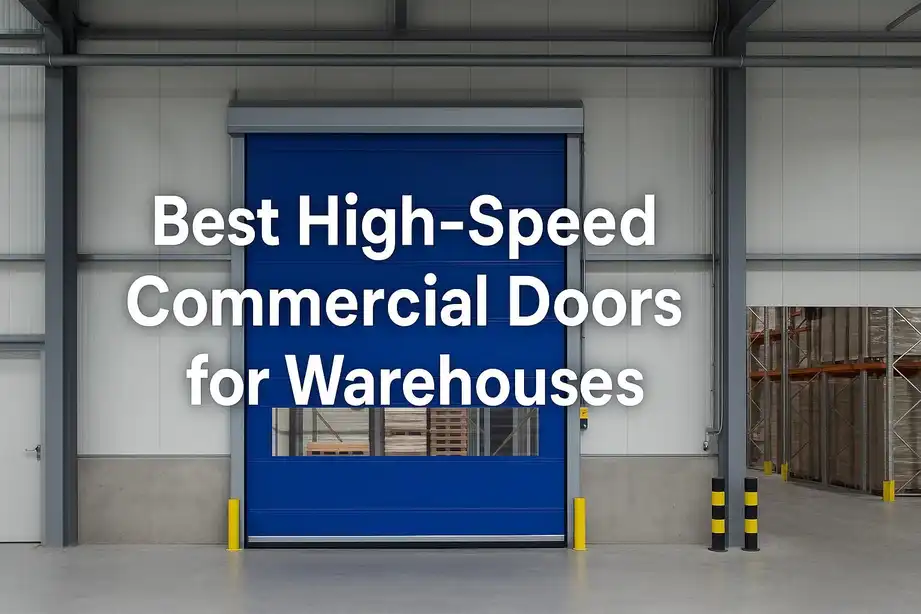

High-speed doors do more than open and close fast. In a busy warehouse or distribution center, the door is a performance tool: it affects throughput, energy costs, and how safely people and forklifts move through an opening. For many facilities, commercial high-speed doors are the upgrade that removes friction at the opening.
This guide compares the main high-speed door types, including roll-up, bi-fold, sliding, fabric, and metal, and walks through the operational benefits and buying factors worth checking before you commit. It also connects those choices to loading dock equipment, warehouse workflow, security, and long-term maintenance.
The best high-speed warehouse door depends on the opening. Rapid roll-up doors are usually the strongest fit for high-traffic loading bays and distribution centers. Fabric doors work well for fast internal openings, metal doors are better for exterior security, bi-fold doors help with oversized openings, and sliding doors fit areas with limited headroom.
Quick Comparison: Roll-Up, Bi-Fold, Sliding, Fabric vs. Metal
| Door type | Best fit | Main advantage |
|---|---|---|
| Roll-up rapid roll | Loading bays and distribution centers | Fast cycles with compact overhead storage |
| Bi-fold | Oversized openings and forklift aisles | Wide clear opening |
| Sliding | Long aisles and limited-headroom areas | Horizontal movement without overhead roll storage |
| Fabric | Interior fast-cycle openings | Lightweight speed and flexible curtain recovery |
| Metal | Exterior or higher-security openings | Stronger durability and protection |
Roll-Up (Rapid Roll Doors)
Roll-up doors are the warehouse standard. They open vertically and coil into a compact roll above the opening. That makes them a strong fit for high-traffic areas, high-cycle loading bays, and facilities where the opening needs to stay clear for product movement. If your facility already depends on conventional rolling doors, this is the high-speed version of a familiar workflow; RCI also covers traditional rolling steel doors for heavier-duty applications.
- Strengths: Fast cycle times, a small footprint, and reliable performance in high-traffic areas and high-cycle loading bays.
- Best for: Loading bays, internal separators, and distribution centers moving product in and out all day.
- Materials: Available in fabric or metal, so you can pick lightweight speed or heavier-duty protection depending on the opening.

RCI Doors™ can help compare rapid roll options for loading bays, distribution centers, and high-cycle warehouse openings.
Bi-Fold Doors
Bi-fold doors fold in panels, either to the side or overhead, creating a wide, clear opening.
- Strengths: A wide clear opening, stable performance in windy conditions, and a good fit for oversized door openings.
- Best for: Forklift aisles and large shipping doors that need more clearance than a standard roll-up provides.
Sliding Doors
Sliding doors move horizontally along a track, which makes them a good fit where there is not enough headroom for a door that rolls up.
- Strengths: Smooth, durable operation with minimal headroom needed.
- Best for: Long aisles and cold-storage or temperature-controlled partitions.
Fabric vs. Metal
Fabric high-speed doors are lightweight and built for speed, which is why they are common as internal separators where cycle rate matters more than raw durability.
Metal high-speed doors are heavier and more secure, which makes them the better choice for exterior openings or anywhere security is the priority. Both types solve the same problem in different ways. The right one depends on how you weigh speed, security, and insulation for that specific opening. The Door & Access Systems Manufacturers Association lists high-performance door technical topics, including terminology, energy conservation, wind load, and safety considerations, in its technical data sheets.
Top Benefits: Energy Efficiency, Reducing Downtime, Improving Workflow
Energy Efficiency
A high-speed door spends less time open than a standard door cycling at the same rate, which means less heated or cooled air escapes. In a climate-controlled warehouse or temperature-controlled load-out area, that adds up to lower HVAC costs and steadier temperatures. Metal doors with thermal cores, or insulated fabric doors with tight seals, get the most out of this. The U.S. Department of Energy also emphasizes air sealing as part of building energy efficiency through its air sealing guidance, and the same building-envelope concept matters at large warehouse openings.
Reducing Downtime
Every second a door sits open is a second where a delay can start. A high-speed door that cycles fast cuts loading and unloading time, shortens the queue for trucks at the dock, and lowers the odds that one slow door backs up the whole operation. If downtime is already becoming expensive, RCI’s guide to reactive commercial door maintenance costs explains why waiting for failures usually costs more.
Improving Workflow
High-speed doors help move people, materials, and equipment without unnecessary stops. Automated sensors and consistent, predictable cycling let forklifts keep moving instead of waiting on a slow door, which is the practical answer to how high-speed doors enhance operational efficiency in warehouses.
Doors that open and close reliably also cut down on the accidents and equipment damage that come from a door that is slow, sticky, or unpredictable.

RCI Doors™ can review cycle volume, forklift paths, loading-bay traffic, and safety requirements before recommending a high-speed door.
Security and Durability
For exterior openings or higher-risk areas, a heavier metal door with reinforced locks and access control does more to protect what is inside. If warehouse door security is the main concern, that is the category to evaluate first. For broader door risk planning, use RCI’s commercial door compliance guide alongside the door specification process.
For internal partitions where speed matters more than raw toughness, fabric doors hold up well in most environments. For high-cycle, high-traffic loading bays that take a beating day after day, metal is usually the longer-lasting choice.
How to Choose: Key Factors to Evaluate
- Speed and cycle rate: How many open/close cycles per hour does the door need to handle? A high-cycle door for a busy loading bay needs a cycle rating built for daily volume.
- Insulation and sealing: Does the space need real temperature control? Check R-values and gasket systems rather than taking insulated at face value.
- Security: For exterior openings, look for reinforced construction and the option to integrate access control.
- Durability: Match the door to the environment. Metal works well for rough, heavy-traffic use; fabric is often better for fast-cycle internal openings.
- Maintenance and downtime: Ask about service intervals and how easy it is to get parts. This determines whether a fast door stays fast over time.
- Integration: Confirm whether the door can connect to warehouse management systems, access control, safety sensors, or other operating controls.
- Cost vs. ROI: Weigh the upfront cost against realistic energy savings and reduced downtime to get an honest payback estimate.
RCI Doors™ can help match the right door type to your warehouse opening, traffic pattern, and long-term operating goals.
Final Thoughts
Upgrading to a high-speed door is an operational decision, not just a maintenance one. Whether the priority is throughput at a busy loading bay, energy savings in a temperature-controlled space, or cutting the downtime a slow door causes, the right door depends on what that specific opening needs.
Ask any supplier about cycle rates, insulation, security features, maintenance plans, and integration options before you commit. Those answers, more than a spec sheet, tell you whether a door will hold up in your warehouse or distribution center. If the opening is part of a larger door system, compare it with related options such as sectional overhead doors and dock equipment before finalizing the plan.
If you want help comparing models side by side, reach out to RCI Doors™. We will help you find the door that fits your operation, not just the one at the top of a brochure.
The right high-speed warehouse door is not just the fastest model. It is the door that matches the opening, traffic volume, safety requirements, insulation needs, and maintenance plan for that facility.
RCI Doors™ helps warehouse, distribution, and industrial teams compare, install, repair, and maintain high-speed commercial doors across North Carolina.

